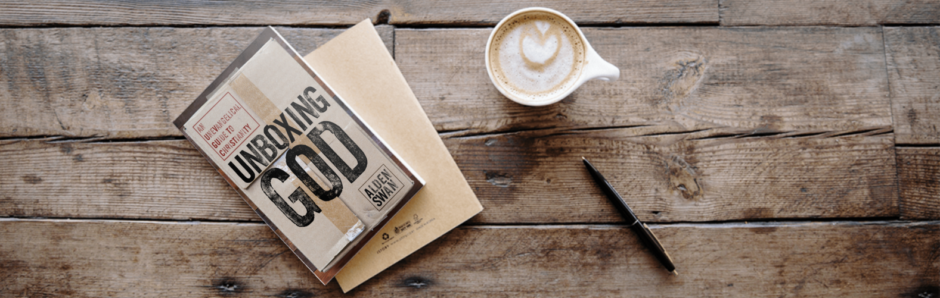
Unboxing God will be released October 15, but you can preorder your copy today! Available in Kindle and paperback. You’ll want the paperback, simply for the cover. It’s that good.
Pen, pencils, and microphone not included.
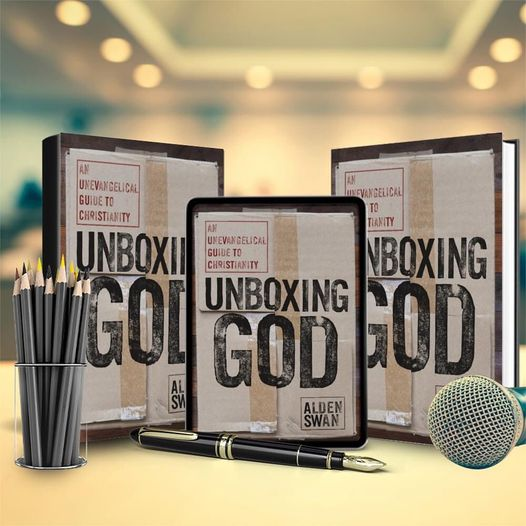
Unboxing God will be released October 15, but you can preorder your copy today! Available in Kindle and paperback. You’ll want the paperback, simply for the cover. It’s that good.
Pen, pencils, and microphone not included.
I am trying out a new Substack account; we’ll see where it goes. Here’s a link to the most current post: You Have A Unique Faith – by Alden Swan (substack.com)
Enjoy!

“Because I’m held together with duct tape” is not the correct answer.
If you are not familiar with the term, deconstruction refers to the process of dismantling or analyzing something–originally a written text–to discover its meaning. More recently, it has come to mean the process of analyzing one’s belief systems. It is quite popular in some of the more “progressive” evangelical circles as those running from a more structured evangelicalism attempt to dismantle their beliefs to find something meaningful. I’m sure some people will take issue with my definition, and that’s to be expected, as the term has seemed to take on a life of its own.
As with so many things, many mainstream evangelicals find deconstruction a frightening concept, as they see it as threatening to the foundation of people’s faith. And, I think there is some validity to this concern, even though I am not an evangelical and have no attachment to many of the structures (boxes) that are being challenged.
One of the possible outcomes of deconstructing one’s faith is that as belief systems are dismantled and discarded, things that were once objects of faith disappear, and the Christian faith itself disappears. Even pastors have walked away from the faith. As the saying goes, the baby gets thrown out with the bathwater. While there may be other factors involved, I do think that a reckless job of deconstruction can be a dangerous thing.
One of my problems with deconstruction is the word itself: it seems to be a waste of a prefix. If you want the opposite of “construction,” there already is a word for that–destruction. It’s more to the point, and it reveals the inherent dangers. There’s a process in forensic science called “destructive testing” where something is taken apart in order to see what caused it to fail. This is the process many refer to as deconstruction. Again, I don’t like the term and don’t use it so not to be confused with some of the more extreme practitioners.
There are some who would say that what I’ve done in my own life, as evidenced in my book Unboxing God–An Unevangelical Guide to Christianity, is a form of deconstruction. Whatever. However, I didn’t start by tearing down the structures to find out what was left.
First, I had recognized that the foundation of my faith was not in systems and structures and doctrines, but in the person of Jesus as testified to in the Bible. Note that I didn’t say that my faith was in the Bible itself, but in the person of Jesus. That’s an important point. Remember, Jesus chastised some Jewish scholars for putting faith in the Scriptures, when the Scriptures were pointing to Jesus (John 5:39). Those who are conditioned to view the Bible as inerrant can have a very hard time some of the realities of Biblical scholarship; to them the Bible has become somewhat of an object of worship. Any of these boxes, as I call them, can become objects of worship and hindrances to real faith.
From that starting point of Jesus, I could look at historically how both Jews and the early Christians viewed the Scriptures, and what they thought about a number of things. Already suspecting there were issues with much of Augustine’s theology and subsequent western thinking, I was able to look at these issues more objectively from a position of faith. This became a strengthening, faith-building exercise rather than the other way around.
I had the advantage of not having been raised in an evangelical setting. Although I lived in that world for many years, it never really took, and I remain unevangelical. For those steeped in evangelicalism, there will likely be some additional hurdles that I didn’t have to face. I hope that the concept of unboxing will be helpful in that regard, as it’s not necessarily destructive. You’re just opening the evangelical box up and seeing the God that’s inside. What you do with the box after that is up to you.
A lot of evangelicalism puts an emphasis on having faith in evangelicalism itself, especially doctrines like infallibility of scripture and taking the Bible literally. There are other issues, but I won’t belabor the point. Attacking one or more of these issues can cause a major faith crisis, because often folks have a hard time telling the baby from the bath water.
I think it’s important, rather than simply deconstructing your faith, to first reorient your faith where it always should have been. Once that is firmly in place, the other issues become less important and should you decide to amend or discard a doctrine or two, it won’t be quite as catastrophic, and may in fact be faith building.
One of the few things that I am certain about–and I’ve said this many times before–is that I am at least partially wrong about much of what I think about God, life, and nearly everything. It’s part and parcel of having a limited capacity for knowledge about the unknowable, which should go without saying. I’m pretty sure which way is up, and that 2+2=4, and that God loves me unconditionally. And, I’m with Descartes in believing that I exist because I’m sitting here thinking about stuff. And I’m also pretty sure my cat exists because he insists on sitting on my keyboard when I’m trying to type. But the nature of the Trinity or what happens when we die? Those things I have beliefs about, but they’re less on the certainty scale.
Those of us who were raised in the post-enlightenment western world tend to see being wrong about anything as a big negative. Through many years of school we learn to cringe at the red checkmarks on our test papers. At least teachers don’t hit students with rulers any longer. It’s even more embarrassing to get an answer wrong in front of the class. Wrong is bad. Making mistakes is bad. When we make a mistake, we say, “I’m sorry.”
What’s up with this? We are all human, we all make mistakes, but we insist that it’s a bad thing and that somehow we should be better than human. Well, excuse me. As a dread pirate once said, “Get used to disappointment.”
And what’s with all the dire warnings about not making the same mistake twice, as if it’s a sure sign you’re doomed? Go ahead and make that mistake twice. In fact, make it five or six times, just to be sure. You’re no less of a person because you’re forgetful.
Have you ever thought about how many scientific experiments are done with the express intent of being wrong in order to rule something out? This is one example of how being wrong can be a good thing. We can learn a lot by being wrong–often more than we can by being right. The danger, of course, is when we put too much weight on our wrong conclusion. Then, when we discover we are wrong, all that is built on top of that conclusion comes crashing down. Not fun.
However, especially if we’re talking about theology (which I often am), it’s important to know where to rest our faith and where to give ourselves the permission to be wrong. This is the problem with much of conservative Christianity, which has built a foundation out of some debatable beliefs. Chances are you know of some churches–perhaps your own–who have some “untouchable” doctrines that not all Christians share. It’s okay to say, “we tend to think this or that,” but to claim that it’s the only way and those who don’t agree are heretics is another matter. To me, these are bright red flags indicating we should beware.
I have a lot of ideas about a lot of topics, and my ideas have changed over the years because as I have read and studied I have found that my old ideas just didn’t stand up to scrutiny. I will argue my new ideas just as firmly as I argued my old ideas, until I find new arguments that outweigh mine. That’s freedom and that’s growth, and there’s joy in growth. In order to grow, I had to have been wrong in the past, or at least that’s what I think now. It’s all an adventure. As humans, we’re free to grow, and that means we have the freedom to be wrong (and to learn from it).
Through it all, I am still certain of a few things that have remained unchanged since childhood, including that God loves me and that Jesus died for the sins of the world. And that chocolate is really good.
